Proudly part of the City Fertility Network



Proudly part of the City Fertility Network
 What is ICSI?
Intracytoplasmic Sperm Injection (ICSI) is a specialised form of In Vitro Fertilisation (IVF) that involves injecting a single sperm into the centre of each oocyte (egg). During ICSI, the sperm doesn’t have to travel to the egg or penetrate its cumulus cells or outer layers. Instead, our scientists use sperm microinjection to inject a single sperm directly into the cytoplasm of the egg. The treated eggs are checked the day after the ICSI procedure to see if fertilisation has occurred.
ICSI is usually recommended where there is a low sperm count, a high number of abnormally shaped sperm, reduced sperm motility, no sperm in a semen analysis or following an unsuccessful vasectomy reversal. It is also recommended for couples who have had previous cycles where standard IVF has resulted in reduced or no fertilisation.
Rainbow Fertility has a range of donor sperm and donor eggs available, with no waitlist. Call our Fertility Advice Team on 1300 222 623 to find out more.
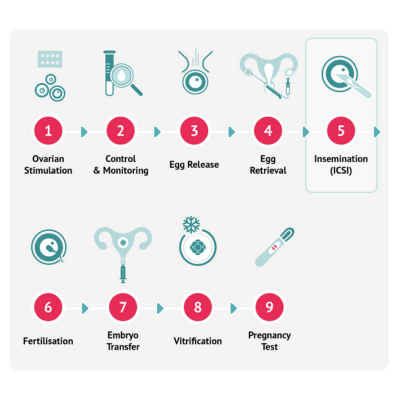
Ovarian stimulation is the first step in an IVF cycle. It involves a series of daily follicle-stimulating hormone (FSH) injections self-administered at home from Day 2 or 3 of your menstrual cycle. This medication is used to stimulate the ovaries to encourage the growth of multiple follicles containing eggs.
Your fertility specialist will closely monitor your ovarian response during the stimulation phase with ultrasounds and/or blood tests. This is important as medications may be adjusted to control the size and number of follicles.
To assist with the final maturation of the egg and loosening of the egg from the follicle wall, ready for egg collection, an injection of Human Chorionic Gonadotrophin (hCG). This is often referred to as ‘the trigger injection’.
The egg retrieval is performed 35-38 hours after ‘the trigger injection’ under ultrasound guidance and takes place while you’re lightly sedated. It is important to note that not every follicle will contain an egg, and not every egg will fertilise.
The key difference between ICSI and IVF is the insemination process. In ICSI, a single sperm is directly injected into a mature egg by a skilled embryologist, whereas in IVF, multiple sperm are added to the eggs and left to fertilise naturally without embryologist intervention.
On the day of egg collection, the semen sample is concentrated, and each mature egg is injected with a selected sperm. The sperm is chosen based on its normal morphology and binding to the media, indicating better DNA integrity for higher embryo development success. Fertilisation is assessed 16-18 hours after injection.
The inseminated eggs are placed in an incubator and checked for fertilisation 16-18 hours after insemination. You will receive an update from the embryologists at this time. The normally fertilised embryos are then grown for five days. It is important to note that not every egg will fertilise, as several factors may affect the fertilisation ability of an egg and/or sperm.
Five days following egg retrieval, the embryos are assessed by the embryologists for development and quality. The best embryo is selected for transfer into the uterus using a fine plastic tube (transfer catheter). Usually, only one embryo is transferred. If more than one embryo is to be transferred, this must be discussed with your clinician before the transfer takes place. Embryo transfer is a relatively quick procedure and discomfort should be minimal.
Any remaining embryos that meet the requirements in terms of development and quality will be frozen. These frozen embryos are then stored until required for a subsequent transfer. The vast majority of frozen embryos survive the freezing process, and pregnancy rates are comparable with the transfer of fresh embryos.
The final stage of IVF is called the luteal phase, and it’s the two weeks between the egg collection and the pregnancy test. Many people find this to be the most difficult time to endure. Whilst it’s an exciting and optimistic time of the treatment cycle, it can often be emotionally charged with expectation and anxiety. You will be encouraged to limit your activity for 24 hours after the embryo transfer, eat well, stay hydrated and keep busy while you wait for your pregnancy blood test.
We understand that every journey is unique. At Rainbow Fertility we tailor your quote to your individualised treatment plan, created for you by your Fertility Specialist. You can visit our Treatment Costs page for a broad overview of our costs.
At Rainbow Fertility, an average of 70% of mature eggs will fertilise normally after ICSI. It is important to note that ICSI doesn’t guarantee fertilisation. There are a number of factors that influence the ability of an egg and/or sperm to create a normal embryo.
ICSI involves injecting a single sperm into a single mature egg. Standard IVF involves adding many sperm to a dish containing the eggs. The sperm and eggs are left for a period of time to allow sperm to penetrate the egg naturally. ICSI is recommended for couples with fertility challenges due to male factors or those where standard IVF has been unsuccessful.
Gender selection is not permitted in Australia unless it’s for medical reasons, such as preventing genetic conditions.
ICSI stands for “Intracytoplasmic Sperm Injection”, a specialised form of In Vitro Fertilisation (IVF) that involves injecting a single sperm into the centre of each oocyte (egg).
Conventional ICSI selects sperm based on appearance (morphology only). The basis for this is that sperm with normal appearance are less likely to contain damaged DNA. Physiological Intracytoplasmic Sperm Injection (PICSI) uses additional factors to select the sperm. At City Fertility, we use SpermSlowTM to perform PICSI. Sperm that are bound by the medium are less likely to have damaged DNA, thus giving the embryologist extra assistance in selecting better quality sperm.
PLEASE NOTE: